Will sun ever shine for George?
Arts Roots, Identity, VoicePosted by sangweni on 2026-05-27 13:48:05 | Last Updated by sangweni on 2026-09-02 06:49:30
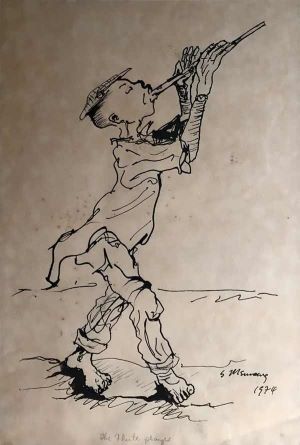
Verifying whether art, like music, is defined by a message in it to be worth the canvas it’s painted on is a recurring thought one constantly tries to fathom to find meaning behind meaning.
It turns into a mental tussle to decipher the sum effect of the vast body of work by different visual artists in a bid to understand how far they have come in their contest to desist spiritual, political and social dominance.
When Phansi Museum sought a writer to tell the story in tribute to black visual artists without blinkers, a world of uncelebrated pioneer black artists opened like a Pandora’s box.
The highlight of this world about the subversive evolution of black art came no better than through George Msimang's tale, a legend from Lamontville township.
Msimang’s work continues to combine telling the story of the underdog through art, shining a light on music, journalism, fashion and being an active citizen of the world.
The story of black visual artists lends itself to speaking truth to power in a way that catapulted art to be the eyes and ears of their surroundings, with a pulse and heartbeat of their communities.
“George Msimang can be regarded as the spokesman for the common people through art’.
This is how fellow artist Paul Sibisi testifies about Msimang, whom he first met in 1969 at Ebony Community Hall in Lamontville - ‘Luxie’ in colloquial township slang.
“George’s drawings of that time were very serious, though in a light-hearted way. He used quick, sharp strokes of his pen to present some of life’s pressing issues of the day.
George will be remembered as an artist, especially in Luxie, who liked wandering, going about and speaking to people of all classes, young and old. In this way, he became sensitive to what society was about.”
Sibisi’s fond remembrance of Msimang’s artistic prowess reveals a colossal figure, who, if it were elsewhere, a statue would be standing tall in his honour in the Moses Mabhida Stadium precinct if not at the entrance of Lamontville itself.
It is a misnomer that many persona-non-grata are visible in today’s altered annals of history, contrived by successive Arts and Culture state apparatchiks in their cruel, selective oversight.
The highlight of the cruel oversight is the renaming of one major street leading to Moses Mabhida stadium ain the vicinity of CR Swart square after a Shebeen king whose name, remains unclear, why it is dishonourably honoured.
It is an oversight that many Black artists are subjected to today that manifests itself in varying degrees of deprivation of decent means to stay afloat in a country afflicted by social ills of endemic proportions.
“Some artists in a democratic South Africa are boiling inside with despair, if not anger, for being on the periphery now that freedom is upon the land of plenty, notes Sibisi with a tinge of sadness.
Ironically, the plenty for the elite runs parallel to abject and grinding poverty that many artists and communities battle out daily, ironically in the absence of inhibiting and punitive apartheid.
The anger is understandable given that the elite who yesteryear never missed recognising artists then, but today, are peeping at the toiling masses through bulletproof state convoys.
Msimang’s epitaph is a tale about the most pivotal but overlooked role of Black artists in fighting and exposing the demon of apartheid through art in the 1970’s.
It was testing times when the Afrikaner Nationalist Party government was on a warpath, suppressing a brewing revolution that exploded on June 16, 1976.
“It is a period Msimang immensely contributed to with one of his works in 1970. The work was chosen amongst four artists to share a $1000 prize awarded by the African Studies Centre at the University of California, Los Angeles. Sibisi chuckles proudly.
Despite this monumental feat warranting heritage status today and the ‘sun to shine on his door’, Msimang possible statue has been overtaken by that of the omnipresent Nelson Mandela & Co in the Mabhida stadium precinct to 'attract' tourists.
Sibisi recounts animatedy how, earlier on, the same year Msimang held a one-person show at the NSA gallery, then still curated by Melrtta Nemirovski..
“That was amongst his first sell-out exhibitions, where a Durban art critic said, ‘Msimang promises to be the most exciting discovery of the year.’
The following year, in 1971, he won an Italian Government scholarship to study at the Accademia di Belle Arti in Rome. After a year’s study in Rome, he held another one-person exhibition at the Bojo Gallery in Salisbury Arcade, Durban.
“I remember his works on show at the Bojo Gallery were reviewed by art critic Marie O’Connor, referring to them as being ‘vital and exuberant’.
During those early years, George’s works sold well, and he had enough money to survive. He always used to dress smartly in expensive clothes, and his shoes were the most sought-after shoes in our peer group.
His bedroom at Ndlwana Road in Lamontville was a real artist’s studio with all his scribbles on the wall.
What really stood out was the highly decorative lettering he’d had used for one of his favourite lines - ‘The sun is gonna shine on my door one day’.
He had bought a very good quality record player, and the track of the LP that we used to play over and over again was ‘Young, Gifted and Black’ by the late Nina Simone.
People said that George’s work at this time reminded them of the drawings of Julian Motau and Dumile Feni.
In a way, George can be regarded as the spokesman for the common people. His art is realistic in style and intense.
We cannot ignore that George, as a Black artist in our then segregated society, was a difficult one, particularly when the market for which his works were produced was ‘white’.
Sibisi’s sincere tribute to Msimang typically casts him as the street-wise township guy with a cunning ability to tell material stories and get away with it against eagle-eyed apartheid spies, avoiding their omnipresent spider web.
“Nevertheless, his drawings were based on experiences of the townships which we were all familiar with. This reminds me of creative Black journalists of the 50’s and 60’s, Nat Nakasa, Bloke Modisane, Arthur Maimane, Can Themba, Casey Motsitsi, Todd Matshikiza, Henry Nxumalo, and Lewis Nkosi, etc.
Those writers really broke the cultural exclusion despite the deepening intrusion of apartheid into their lives.
Msimang artworks did in his soujouirns challenge how religion and politics were weaponised to entrench the contrived impoverishment of black people, which is not a preserve of Afrikaners and the birth of apartheid in 1910.
The building blocks of apartheid and oppression to be firm were stacked firmly against black people by the English in the 18th century.
It is poetic justice how the dead body of apartheid has been preserved in a pall of ash by George, similarly like in the Biblical story about the end of Sodom and Gomorrah.
The end of Sodom and Gomorrah and apartheid paradoxically compares to the ruin of Pompeii, after the eruption of Vesuvius in AD 79, where some victims in that Roman city were encased in volcanic dust, that captured them in a pall of ash, an artistic creation that has stood the test of time.
Should those that made others suffer for selfish reasons not be cast in a pall of ash in real or in the afterlife, as God must first make them suffer before dispensing his heavenly justice in his vast Kingdom?
Msimang is a classic case of how many notable black visual artists pushed back against hegemonic religious art of the 1960’s transcending to the evocative struggle images of the 1970’s and radical clenched fists in the air of the 1980’s and finally the storm before calm of the 1990’s.
Art Moment Lost Forever
The era after the historic 1994 ‘miracle’ elections ushered the ‘Rainbow Nation’ with deafening euphoria now fading like a drifting shoreline without finding bright expression in public art.
Art by the people, with the people and for the people through imaginative community murals was a major shift on how art is dispensed as opposed to Technikon and university-based art education.
Grabbing mural images in public spaces gave meaning to voices about freedom, human rights, discrimination, racism and justice.
The seismic shift opened artistic floodgates for some of the historically disadvantaged individuals (HDI’s), a colloquial term in reference to tje poor by design notwithstanding more than 300 years of their arrested development.
Freedom came 11 years later on the back of a sad distant chapter after the closure in 1983 of one and only accessible black school of art, the Lutheran Church run Rorke’s’ Drift,
The art school was a cut above the rest in the development of art and artists though laced with Christian and religious propaganda before the influx of some of the 1976 rebellious chicks.
As a metaphor against religious capture of black people, Msimang’s artistic prowess reveals a colossal figure.
In one of the exhibitions, Msimang’s artworks marked the beginning of an end of an era of the Christian based artworks inspired by religious teachings that defined Rorke’s Drift focus as attested to by one Inter-faith exhibition of paintings and wood carvings at the Durban Art Gallery in 1965.
The exhibition was organised by Mr Hall Duncan of the World Council of Christian Education, Sister Pienta of Marianhill and the Rev. Maurice Fearns of the Methodist Church.
The exhibition was opened by Rev. Cyril Wilkins of the Methodist Church, a former inspector of ‘Bantu Arts and Crafts’ and Mr Jack Grossert of the Roman Catholic Church.
In its report on the event, The Mercury newspaper of December 3, 1965, the writer highlighted that ‘paint brushes made from shrubs were extensively used and a few of the paintings have been worked on tent canvas as the artists could not obtain or afford to buy the artists proper canvas.
“Most of the works of art illustrating Christian beliefs are in the Western style and the result is that primitive peoples, to whom the Christian faith has been brought, think of Christ as European.
About a year ago we decided to try to locate talent and to see that the talent in existence was used for furtherance of Christian religious education.”
Mr Duncan said that Christian faith could be made more meaningful to ‘primitive people’ through art.
These disturbing revelations do warrant an Artists’ Truth and Reconciliation Commission for the man of cloth to confess their sins on furthering oppression, colonialism instead of the Gospel truth.
That five years later Msimang went awol out of Rorke’s Drift in 1969 escaping Inter-faith wolves in sheep skin going as far Rome but resisted the temptation to do as the Romans do, is still another of many rare feats.
Msimang’s departure from Rorkes’ Drift exposed fault-lines between religion, tribalism, racism and apartheid politics in South Africa that could not give him the recognition and freedom he yearned for.
It is against this background that Msimang is as artist who mingled with his people especially in Lamontville to be conversant with their trials and tribulations and the daily grind.
Msimang’s mission could not even be rattled by personal schisms with fellow emerging artists in Rorke’s Drift he unfortunately left under a cloud albeit maybe that freed him out of a religious grip.
Msimang plight and fate is a reminder that artists are not infallible though they are perceived to possess innate spiritual and intellectual capability to handle conflict through art and creative means.
The role of the English in annihilating black peoples’ culture and religion is amplified in the wicked observation by one colonial master, Lord Macaulay’s address to the British Parliament on February 2, 1835.
“I have travelled across the length and breadth of Africa and I have not seen one person who is a beggar, who is a thief, such wealth I have seen in this country, such high moral values, people of such calibre that I do not think we would ever conquer this country, unless we break the very backbone of this nation, which is her spiritual and cultural heritage.
And therefore, I propose that we replace her old and ancient education system, her culture, for if the Africans think that all that is foreign and English is good and greater than their own, they will lose their self-esteem, their native culture and they will become what we want them, a truly dominated nation”.
Most black visual artists were inadvertently in a quest to exorcise Macaulay’s curse and be like George who lived by his encouraging motto: ‘The sun is gonna shine on my door one day’.
Whether art, like music, is defined by a message in it to be worth the canvas it’s painted on has been answered if George’s work evoked thoughts about fashion, love and despair, on equal terms.